
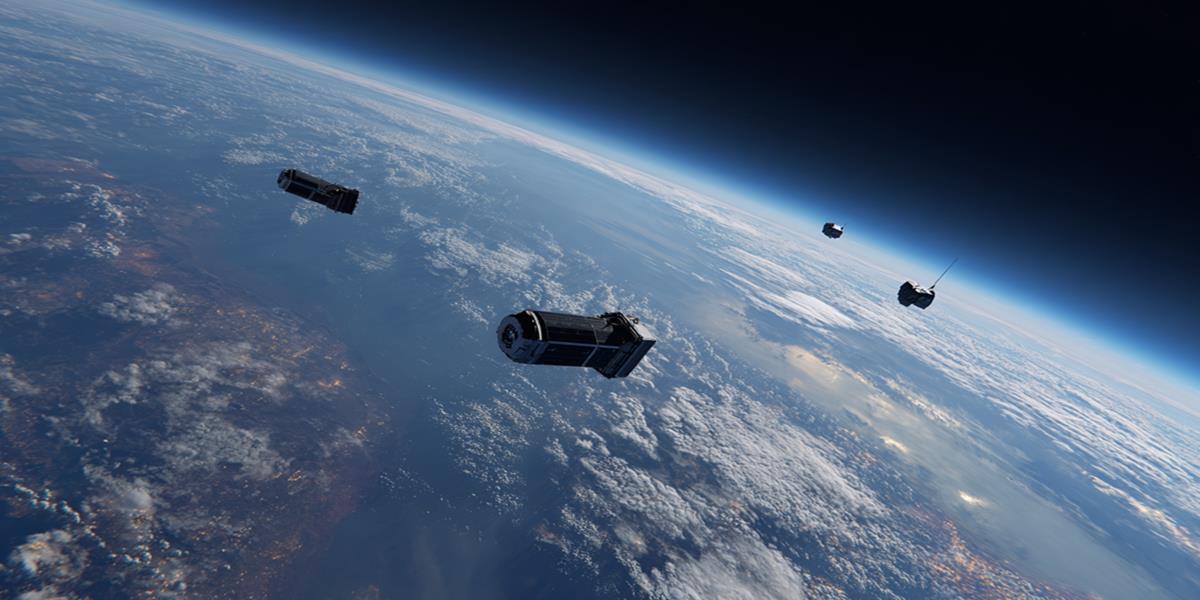
So crowded, in fact, that SpaceX has decided to move a huge chunk of its Starlink constellation out of the orbital fast lane.
Over the next year, roughly 4,400 Starlink satellites will be lowered from their long-standing operating altitude of about 550 kilometers to roughly 480 kilometers above Earth. The official reason is safety: fewer close calls, faster cleanup if something breaks, and a lower risk of a debris cascade that could turn low Earth orbit into an unusable junkyard.
That explanation is true.But it’s only half the story.
Because once you start lowering satellites at this scale, the real question isn’t why. It’s how low can they go — and what does it really cost?
Why SpaceX is moving now
Low Earth orbit has quietly turned into the busiest real estate market humanity has ever created. Thousands of satellites are already up there, and tens of thousands more are approved or planned. Every new object increases the odds of near-misses, evasive maneuvers, and failures that leave dead hardware drifting for years.SpaceX knows this better than anyone. Starlink satellites already perform tens of thousands of collision-avoidance maneuvers every year. That’s not a future problem. That’s today’s operating reality.
Then came an uncomfortable reminder late last year: a Starlink satellite suffered an in-orbit anomaly, lost control, and fragmented. The debris was limited and reentered quickly, but the message was clear. In a dense environment, even rare failures matter.
Lower orbits change that equation. Below about 500 kilometers, atmospheric drag does something useful: it pulls failed satellites down naturally. Dead hardware doesn’t linger for decades. Gravity cleans up faster.
That’s the logic behind the move. And on paper, it looks responsible.
The invisible line SpaceX can’t cross
Dropping from 550 km to 480 km doesn’t sound dramatic. In orbital terms, it’s conservative. Latency barely changes. Coverage stays intact. Starlink customers won’t notice.But go lower, and physics starts sending invoices.
Below ~400 kilometers, satellites feel real atmospheric resistance. They slow down constantly. To stay in position, they must fire thrusters more often. That burns propellant. Burn propellant faster, and the satellite’s life gets shorter.
Around 340–360 km, which SpaceX has explored for parts of its next-generation constellation, station-keeping becomes a daily concern rather than background noise. It’s doable, but it’s not cheap.
Below 300 km, things get brutal. Without near-continuous propulsion, satellites decay quickly. Miss a few burns, lose control, and reentry follows within weeks or months. For experiments, that’s fine. For a global internet backbone, it’s a gamble.
That’s why ~480 km is the sweet spot. Low enough to reduce long-term debris risk. High enough to keep satellites alive without fighting the atmosphere every hour.
The trade nobody talks about: faster replacement
Lower orbits don’t just reduce debris. They shorten satellite lifetimes.At 550 km, a Starlink satellite is typically designed to operate for five to seven years. At 480 km, that drops closer to four to five years. Push parts of the network lower, and you’re looking at three to four years unless the design changes.
Multiply that across 4,400 satellites, and the math gets serious.
To keep capacity flat, SpaceX may need to replace 800 to 1,100 satellites every year, up from roughly 600 to 700 under higher-orbit assumptions. This isn’t a temporary spike. It becomes the new normal.
In other words, safer orbits mean faster churn.
The real cost of “playing it safe” in space
SpaceX doesn’t publish Starlink unit economics, but industry estimates are well understood.Annual replacement cost for the lower-orbit fleet:
- Satellite manufacturing: ~$250,000 to $500,000 per unit
→ $200–500 million per year - Launch costs (internal Falcon 9 pricing): ~$15–20 million per launch, ~20–25 satellites per rocket
→ $600–900 million per year - Operations, integration, tracking, deorbit management:
→ $100–200 million per year
Total annual renewal bill:→ Roughly $900 million to $1.6 billion — every year
This is the quiet genius of SpaceX’s model. Because it builds the satellites, flies the rockets, and controls the constellation, it can afford a strategy that would crush most competitors.
But make no mistake: lowering orbit turns sustainability into a recurring operating expense, not a one-time design choice.
A cleaner sky, with a new kind of pollution
There’s another side effect few people mention. Faster reentries mean more satellites burning up in the atmosphere. When they do, materials like aluminum don’t vanish. They turn into microscopic particles that linger in the upper atmosphere.Scientists are only beginning to understand what happens when satellite reentries scale from dozens per year to thousands. The long-term impact on atmospheric chemistry is still an open question — and one regulators are watching closely.
So the trade becomes uncomfortable: Less junk in orbit, more material in the atmosphere.
This isn’t just about Starlink
By lowering its satellites, SpaceX is quietly setting a benchmark.The message to regulators and rivals is clear: If you want to operate megaconstellations at scale, you don’t get to park hardware in orbit forever.
Lower orbits force accountability. Failures clean themselves up. But they also demand constant launches, constant manufacturing, and constant capital.
SpaceX can live with that. Others may not.
How low can they really go?
In theory, all the way down — every satellite can be guided into controlled reentry if it still responds.In practice:
- ~480 km looks like the new workhorse altitude.
- ~350 km is viable, but expensive and unforgiving.
- Below ~300 km is a hard sell for a global network, no matter how good your rockets are.
SpaceX isn’t racing toward the atmosphere. It’s edging closer, carefully, knowing exactly where the cliff starts. And that’s the real story behind the move: Not a dramatic descent — but a calculated one, where every kilometer lower trades comfort for control.
The sky may look the same from Earth.
Up there, the margins just got thinner.

Sam Altman is talking about trillion-dollar AI infrastructure. ChatGPT’s revenues tell a more complicated story.

SaaStr says AI replaced sales. The real reason is buried in the numbers, the business model, and a growth story that isn’t what it used to be.

A $2.9 billion Tesla battery deal shrank to just $7,000 in days. Here’s how the 4680 hype, Cybertruck reality, and market mood swings wiped out 99% of its value.

Explore how BYD is challenging Tesla in the global EV market with record sales, stronger margins, and rapid expansion. A data-driven comparison of the world’s top electric vehicle companies in 2025.

Hermès just overtook LVMH as the world’s most valuable luxury brand—by doing less.
The economics behind it will change how you think about brand strategy.

They didn’t storm the gates — they bought them.
How Goldman Sachs and J.P. Morgan helped China quietly acquire billion-dollar Western companies — and why Trump’s new tariffs could shut the door for good.